Project Overview
Brief- Thesis Project
Industry- Fintech, Productivity
Timeline- 12 weeks
My Role- UX/UI Design, Product Strategy, Copywriting
Challenge
7 million people in the UK file as self-employed, and none of them have a payroll system, an HR department, or automatic deductions absorbing the admin on their behalf. 27% of freelancers cite anxiety as a significant reason for putting off filing altogether.
Research showed that tax anxiety isn't only about complicated tax law, it's also about cognitive load accumulating throughout the year until it becomes unmanageable at filing time.
Approach
But people don’t keep up with their books. Not consistently. So the question wasn’t how do we build consistent book-keeping habits.
It was:
can book-keeping happen without asking users to log?
So, instead of relying on manual input, we aimed to auto-detect income, expenses, and deductibles, ask for lightweight confirmation, and only involve the user when necessary.
The opportunity was designing to meet users halfway by reducing burden, but not removing agency.
Swipe to stay on top of it
Designed for speed
Instead of asking users to log income and expenses, we surface likely transactions with AI-suggested HMRC-friendly categories based on match, memory, predictions and rules. Mileage is tracked automatically. Scanned receipts and invoices are matched.
Users can confirm or reject with a single swipe.
The interaction was designed to fit between jobs, on a lunch break, end of a working day, waiting for a client to reply. Small actions, repeated across the year, replace the annual crunch entirely.

Unifying the system across surfaces
Categorisation can be triggered from multiple entry points. Homepage, tasks list, transaction history.
The experience adapts slightly based on context, but the core interaction remains consistent.
This keeps the system predictable while flexible.

Surfacing tasks by priority
These show up as cards on the admin task list. Each card provides context behind the detection.
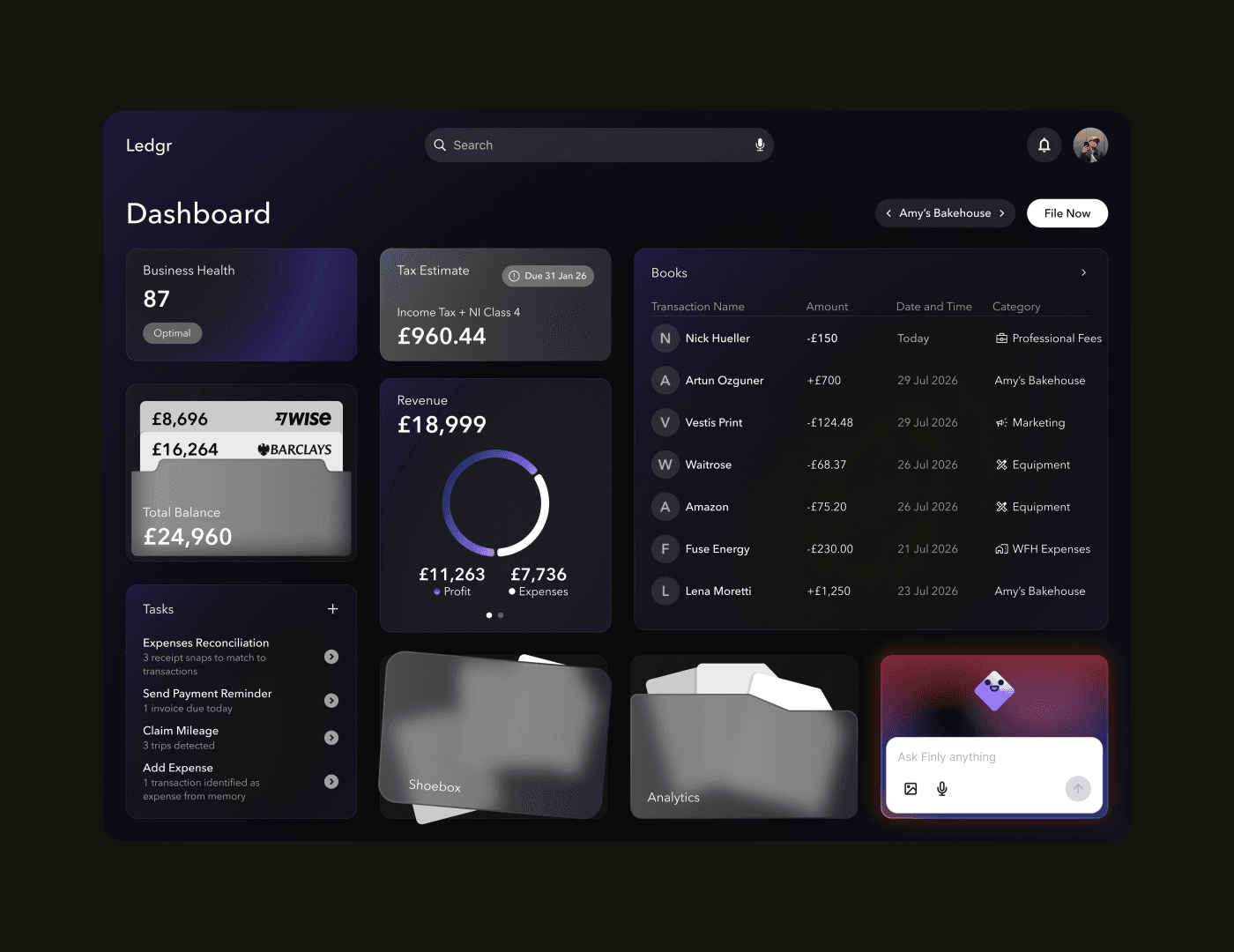
Tasks include an unmatched receipt, an invoice due, a mileage trip to claim, a transaction to be reconciled. These are ranked by priority- high, medium, and low. No hunting through tabs and menus, no remembering what's outstanding.
This connects awareness to action without requiring navigation.


Business health, not financial jargon
Minimising confusion, preserving control
Financial health is presented in a way users understand it.
Data from all financial reports is boiled down to a single Business Health score with a plain-language explanation behind it. A read on how the business is doing, written the way a knowledgeable friend would explain it.

Not a graph to interpret
Ledgr tells you what financial statements like profit and loss, cash flow, and balance sheet, mean.
When financial information increases mental effort, decision quality drops. A user who sees a score and a two-sentence summary understands their finances and can focus on improving highlighted points of concern.


Long press to understand why
Making guidance contextual to scenario
Users were already googling and using AI.
Every unfamiliar term sent them to a new tab, an HMRC guidance page written for accountants, and a paragraph they'd read three times without it clicking. Research confirmed this was routine mid-task, mid-form, losing the thread every time.

Designed for longitudinal learning
A long press on any label in Ledgr awakens Finly. She explains the term in plain language, gives a personalised example based on the actual transaction, and clarifies why it matters for that specific filing situation.
The guidance appears at the point of decision. In context. Without breaking the flow. The goal was to slowly build financial literacy and stop making people earn it the hard way every single time.
Finly- filing with someone beside you
Shift filing from a task to a learning system.
Filing is the moment taxpayers dread most. Finly changes the dynamic.
Because it has stored the year's transactions, categories, and records, it already knows most of what the form asks. It walks through filing conversationally, translates each field into plain English, flags errors, and surfaces contextual guidance at each decision point.

Finly doesn't file for you. It sits beside you while you do it. This can improve both accuracy and user confidence.
That distinction is the whole point.

In conclusion,
Ledgr shifted tax admin from a seasonal crisis to a background practice without asking users to become more disciplined or more financially literate before it could work.
By prioritising small actions over big ones, contextual guidance over reference documents, and smart suggestions over silent automation, the system reduced cognitive load without removing the user's understanding of their own money.
The key decision was to never do the thinking for the user.
Instead of automating away the hard parts, Ledgr surfaces them in a form that's easier to engage with, so that over time, users file accurately by understanding what they are filing.